Completion of Doctorate in Musicology
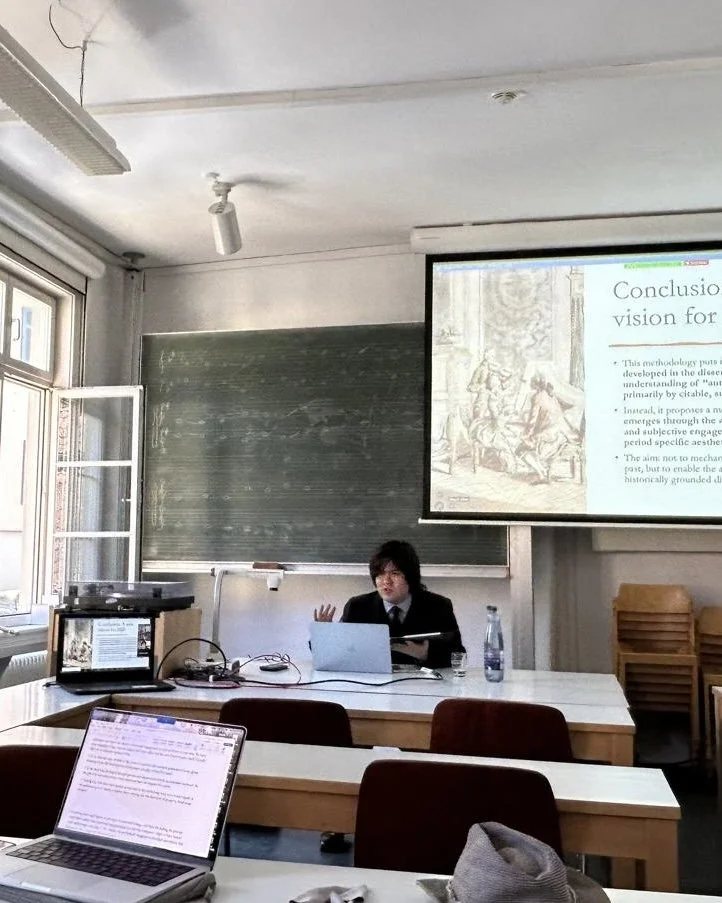
On 28 May 2026, I completed my PhD at the University of Tübingen with a dissertation entitled A Rhetorical Approach to the Historical Performance of Keyboard Music: 1740–1830 at the University of Tübingen. The dissertation was supervised by Prof. Dr. Matthew Gardner, Dr. Jed Wentz, and Prof. Dr. Stefan Morent.This project has been the culmination of several years of work as a performer, musicologist, and artistic researcher, bringing together my interests in historical keyboards, eighteenth- and early nineteenth-century aesthetics, rhetoric, sensibility, acting, and historically informed performance. At its core, the dissertation asks a simple but difficult question: what did it mean, historically, to play music with “feeling”?
The thesis begins from a problem in the theory of historically informed performance. HIP has often been understood as a practice grounded in recoverable, external evidence: the score, notation, historical instruments, technique, ornamentation, articulation, tempo, and style. These things are essential. But many eighteenth- and early nineteenth-century writers did not understand musical expression as a matter of mechanically reproducing correct external features. They repeatedly speak of feeling, imagination, sensibility, and the power of performance to move an audience. My dissertation therefore argues that a historically informed performance should not only ask what can be objectively recovered from sources, but also how those sources can be animated by the performer’s inner emotional and imaginative engagement.
To develop this idea, I turn to classical rhetoric as it was understood in the age of sensibility and early Romanticism. Rather than treating rhetoric merely as a system of figures, topics, or analytical labels, I focus especially on actio: delivery. In rhetorical culture, delivery meant the embodied realization of thought and feeling through the use of the voice, face, and gesture before an audience. I argue that this provides a powerful historical model for the performer. The musician, like the orator or actor, does not simply transmit a text; they re-animate it. Through what I call “coupling,” the performer links external features of the work with internal feeling, so that notation, style, and musical rhetoric become communicative, affective, and alive in performance.
The vision of HIP that emerges from the dissertation reframes fidelity itself. Fidelity remains grounded in sources, instruments, notation, technique, and historically recoverable practices, yet it also reaches into the aesthetic psychology through which eighteenth- and early nineteenth-century performers understood expression. To be faithful to this repertoire, then, is to engage not only with its surface details, but with the historical ways in which imagination, judgement, taste, sensibility, and embodied delivery transformed those details into living" expression. This brings fidelity deeper: from correctness of external features toward a historically informed mode of artistic “genius” through thought processes and feeling.
In this sense, HIP becomes a dialogue with the past. The performer is not bound to replication alone. Historical traces provide the starting point: the score, the instrument, the technique, the style, and the sources. But these traces must be taken up by a living person: the performer of today. The traces must pass through the performer’s own feelings, imagination, judgement, and inner creativity. Through this process, musical “meaning” is mediated through performance. The performer encounters the work, responds to it, and makes its expressive content their own.